
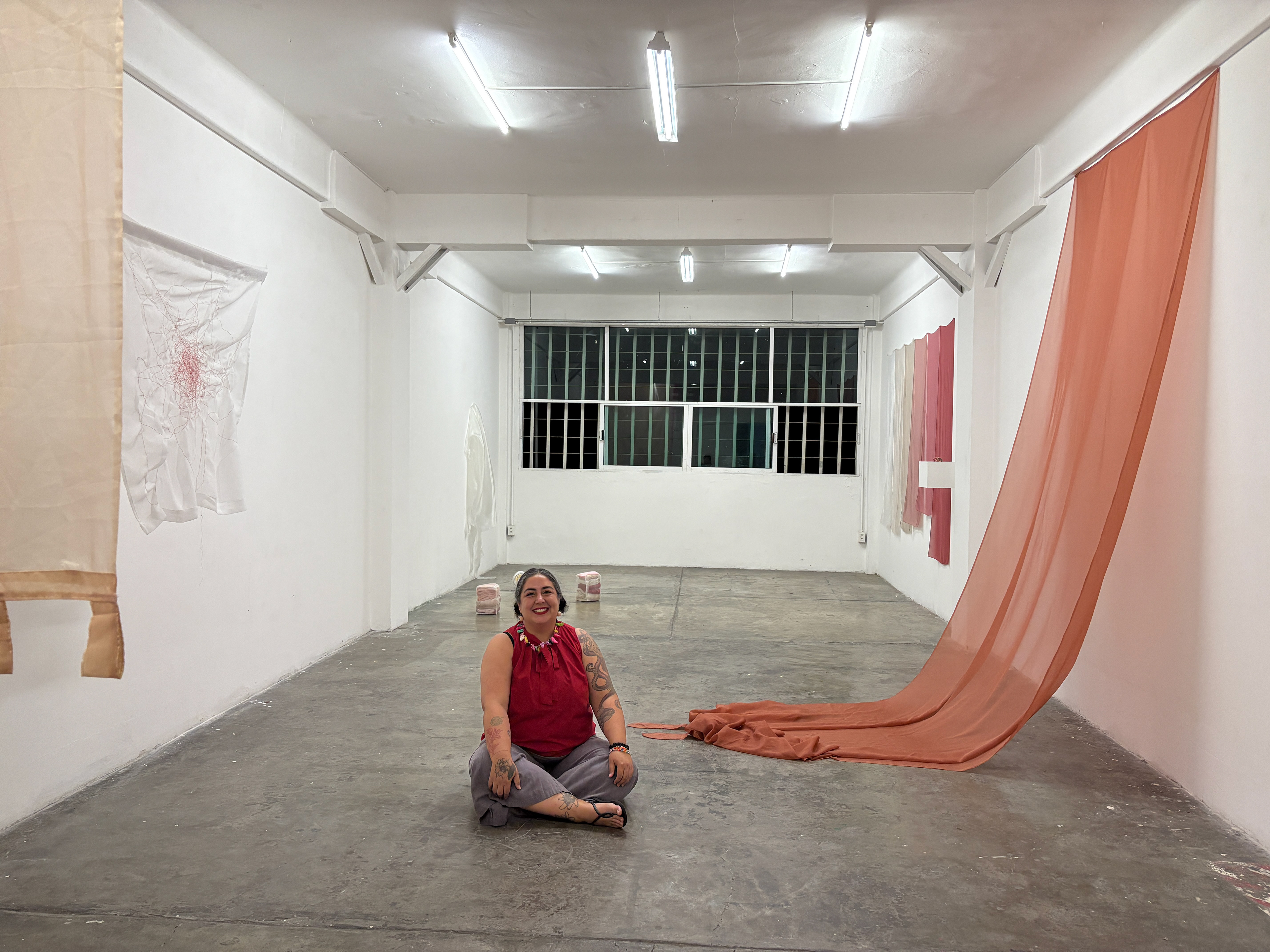
Esther Gámez was born in Hermosillo, Sonora, México and moved to Ensenada in 2004 where she has spent most of her professional life. Bachelor in Visual Arts with a major in printmaking. Her work has been exhibited nationally and internationally in over 150 group shows in México, United States, Spain, and Qatar, as well as 14 solo shows.
An active member of her local art scene, Esther often wears the hat of cultural promoter and curator for other emerging artists. She is a founding member of Yerbamala Taller, a studio and art collective focusing on developing and supporting women and non binary artists; La Covacha (An independent cultural space from 2012 to 2016) and SIDIMPRO (Semana Internacional de Improvisación) an improvisatory arts festival that recently had its 10th edition.
Her work as a live visualist with important trans-border improvisers and musicians has bled into her personal and creative processes, and considers improvisational aspects as an antithesis to automatization and artificial intelligence and highlightin the human hand in creating real time visuals.
Among the highlights of her career, you can find several prizes and selections from international organizations such as ADC/Building Bridges, Bice Bugatti, LA Art Show, Qatar Cultural Center, Paisanos (bi national art show in collaboration with the US Consulate), The US Consulate in Arizona, International Public Arts Festival IPAF, PECDA BC, and Bienal de Arte de BC. As of 2023, she has been inducted in the Sistema Nacional de Creadores de Arte, one of the most important national grants for the arts.
Esther is a restless artist who has chosen to be open about the many paths and styles a creator has to walk in order to be able to survive and thrive. Her works cover traditional media such as drawing, painting and printmaking, but spills into the experimental working with found materials, textiles and even tattoos.
Everything seems to fit within Esther's generous creative universe. The emergence and blooming of life, yes, but also its decay, the decomposition of organic materials that were once admired, loved, and vigorous human, animal, and vegetable bodies. The absurd culture of waste and obsolescence. The arbitrary invention and upholding of gender and inequities, along with the resistance and transformation that these conjure up. The desert, the sea. Flora, fauna. The complexity of human struggle, especially of women. Everything is revealed as palpably beautiful in the work of this reluctant shaman of the ordinary, a witch of the mundane, a witness and translator of the cycles of life, both permanent and transitory.
Wilfrido Terrazas